Agfa HealthCare vs Medicai for Deep EMR Integrations
Your hospital just spent eighteen months on an EMR upgrade and now the imaging team cannot pull studies without logging into three separate systems. The integration gap now forces radiologists to duplicate work daily.
By the final section you will know which platform delivers DICOM gateway access inside your EMR without extra servers, how each handles cloud PACS and AI routing inside existing workflows, and which pricing model aligns with your volume. The verdict lists concrete differences you can check against your current vendor contract.
Quick Verdict: Agfa HealthCare vs Medicai for Deep EMR Integrations
Medicai provides zero-footprint DICOM access and HIPAA-compliant APIs that integrate directly with EMR systems for streamlined imaging workflows.
Agfa HealthCare typically relies on enterprise licensing models and on-premise infrastructure for its imaging solutions. These approaches often require extensive IT resources and longer implementation timelines.
Medicai operates as a cloud-native platform that delivers faster deployment cycles. Organizations benefit from reduced hardware dependencies and quicker access to imaging data across clinical systems.
Both platforms handle standard healthcare data exchange protocols. Medicai supports DICOM, HL7, and FHIR standards through its API infrastructure while maintaining HIPAA and GDPR compliance.
Transaction volume provides insight into platform reliability. Medicai processes 50M+ yearly API transactions and manages 1M+ studies annually across 70 clinics and hospitals.
Cost structures differ significantly between the two approaches. Agfa HealthCare generally involves substantial licensing fees and ongoing infrastructure expenses. Medicai offers a SaaS model that eliminates hardware investments and reduces total cost of ownership.
Deployment flexibility matters for organizations with varying IT capabilities. Medicai requires minimal on-site resources while delivering FDA/CEE cleared viewers and maintaining OWASP security standards.
Integration capabilities extend to existing PACS and RIS environments. Medicai enables direct connectivity with EMR systems, supporting clinical workflow automation without complex middleware solutions.
At a glance: how Medicai compares to Agfa HealthCare, Medicai for Deep EMR Integrations on the features that matter most.
| Feature | Medicai | Agfa HealthCare | Medicai for Deep EMR Integrations |
|---|---|---|---|
| Deep EMR Integrations | ✓ | — | ✓ |
What Is Medicai?
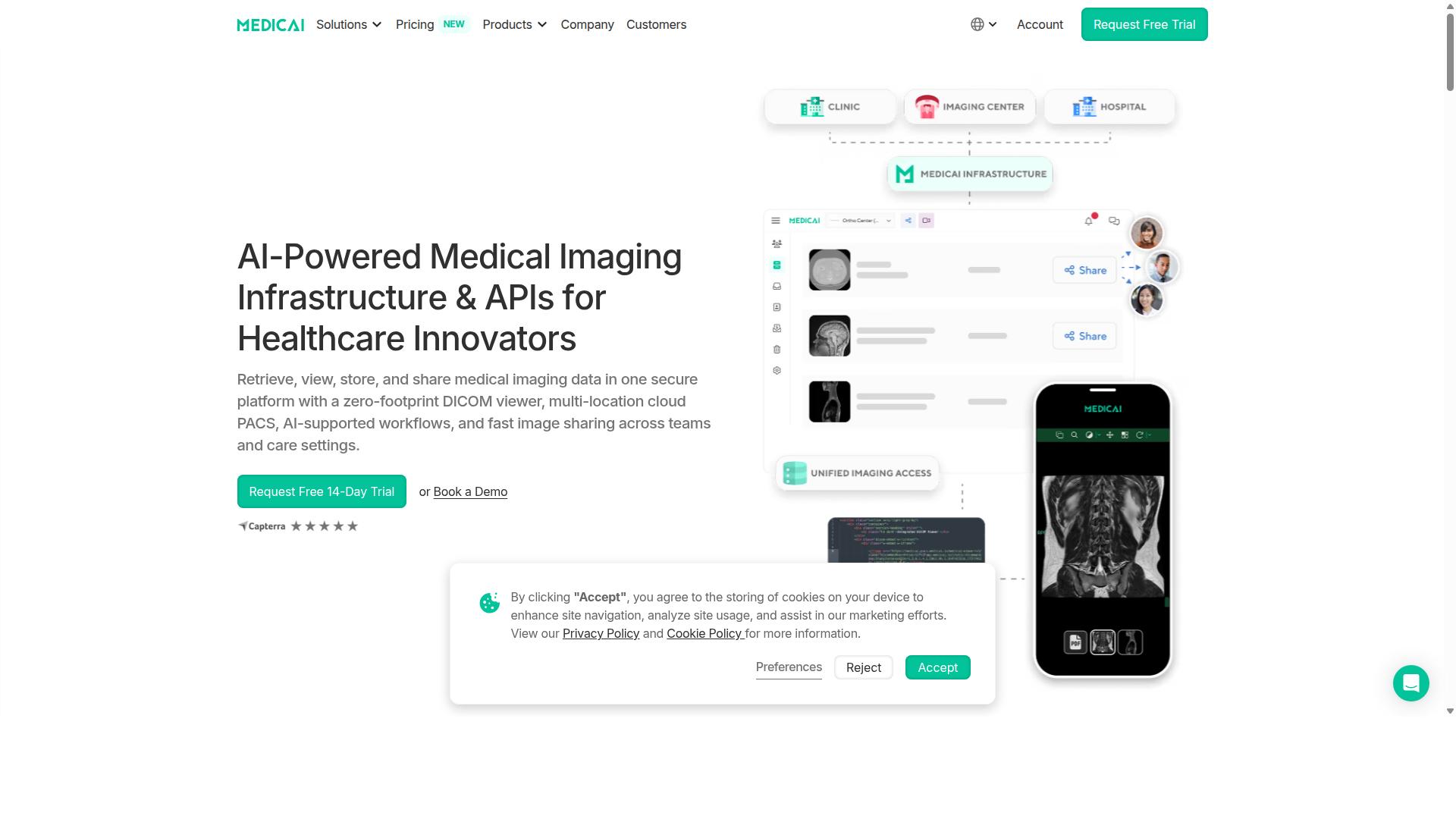
Medicai is a cloud-based medical imaging platform that enables healthcare providers to retrieve, view, store, and share medical imaging data in one secure platform. The service combines several core components that support modern clinical workflows across different care settings.
The zero-footprint DICOM viewer operates directly in standard web browsers without requiring local software installation. This architecture reduces hardware dependencies and simplifies access for clinicians working across multiple facilities.
Multi-location cloud PACS forms the storage backbone of the platform. Images and associated data remain accessible from any location with internet connectivity, supporting both routine clinical review and urgent consultation scenarios.
AI-supported workflows help streamline routine imaging tasks and improve operational efficiency. These capabilities work together with existing clinical systems to maintain continuity across different healthcare IT environments.
Fast image sharing across teams and care settings enables rapid collaboration among radiologists, referring physicians, and specialists. The platform supports clinical data exchange through standard healthcare interoperability protocols including DICOM, HL7, and FHIR.
As an Imaging Infrastructure as a Service (IIaaS) provider, Medicai focuses on modernizing medical imaging workflows and enabling healthcare interoperability. This approach helps organizations manage medical imaging data without maintaining complex on-premises infrastructure.
What Is Agfa HealthCare?
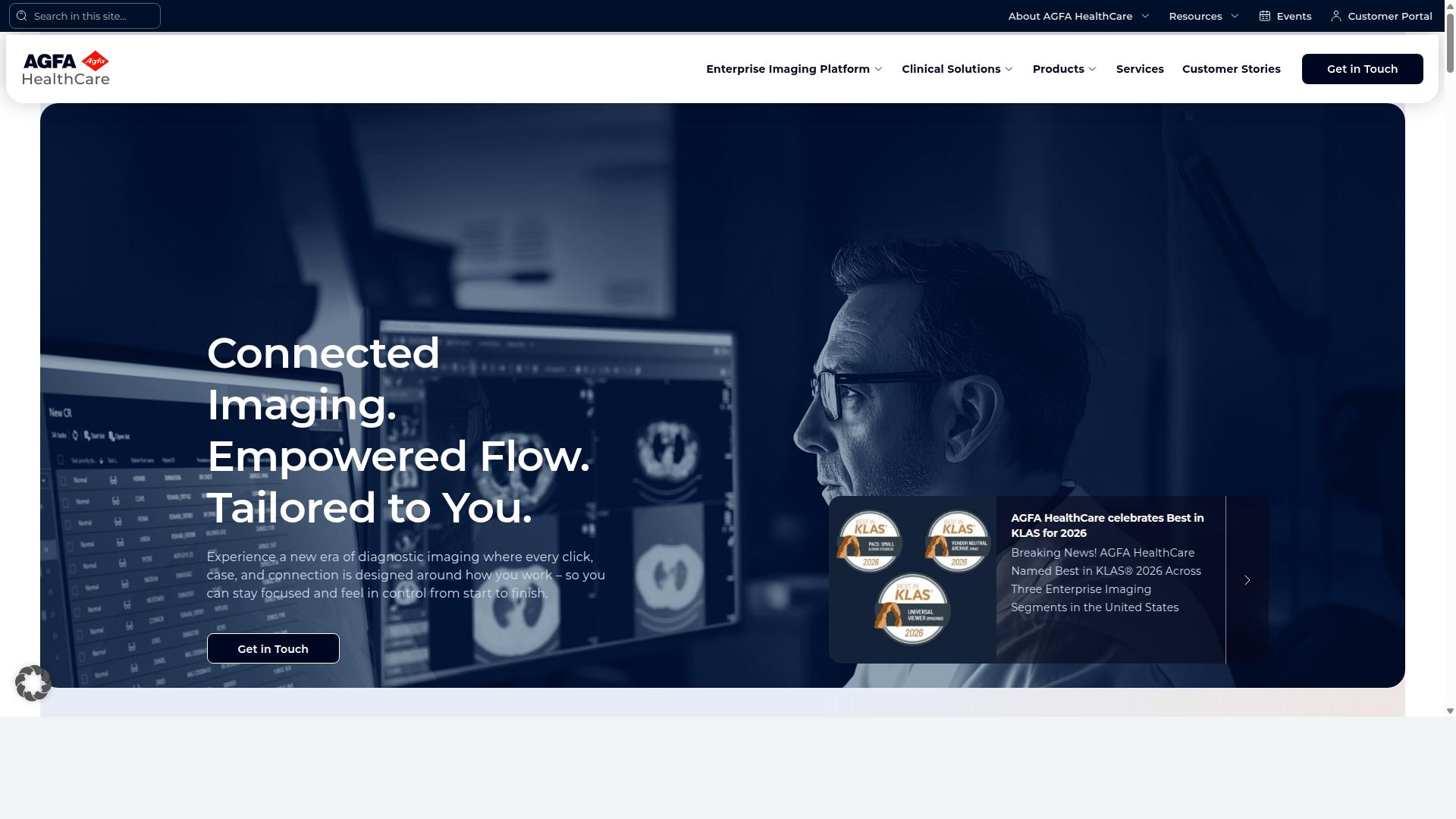
Agfa HealthCare is an established enterprise imaging vendor offering PACS, RIS, and enterprise imaging solutions primarily installed on-premises or in hybrid environments.
These systems support organizations that require local control over medical imaging workflows and data storage. Many facilities continue to choose this approach because it aligns with existing IT policies and security requirements.
Enterprise imaging platforms from Agfa HealthCare typically handle DICOM image management, radiology information system functions, and integration with existing clinical systems through standard healthcare protocols.
Healthcare organizations evaluating these solutions often consider factors such as implementation timeline, ongoing maintenance responsibilities, and the level of technical expertise needed for system management.
Traditional enterprise imaging vendors like Agfa HealthCare generally focus on comprehensive installations that serve large hospital networks and established radiology departments.
What Is Medicai for Deep EMR Integrations?
Medicai leverages its 50 million yearly API transactions and HIPAA/GDPR-compliant infrastructure to connect imaging workflows directly with existing EMR and EHR systems. Deep EMR integrations allow healthcare organizations to access imaging data without switching between multiple applications.
The platform achieves this through three core modules working together. These modules handle image acquisition, secure exchange, and case organization while maintaining compatibility with standard healthcare protocols.
DICOM Gateway serves as the primary connection point. It retrieves imaging studies from various modalities and sends them to the EMR using established DICOM standards.
Medical Image Exchange facilitates secure transfer of studies between institutions. This module ensures images arrive in the correct format for EMR consumption without manual intervention.
Patient Case Management organizes imaging data into structured cases. It links relevant studies with patient records, enabling clinical workflow efficiency across departments.
These modules operate through standard protocols including HL7 and FHIR. The system feeds data into existing EMR platforms without requiring duplicate storage or complex custom development.
Features Compared
A feature-by-feature examination of imaging and integration capabilities across both platforms.
Deep EMR integrations require reliable data exchange, standards compliance, and flexible access methods. The analysis focuses on three key areas.
These capabilities determine how well each solution supports clinical workflows and patient record management.
DICOM Gateway & EMR Connectivity
Medicai's DICOM Gateway enables secure, bidirectional imaging exchange between modalities and EMRs using DICOM, HL7, and FHIR standards.
The gateway automates study ingestion and pushes imaging metadata into EMR patient records with zero-footprint access for clinicians. This approach reduces manual data entry and supports consistent patient record updates across systems.
Agfa HealthCare solutions typically rely on established DICOM and HL7 protocols, though deployment models vary by installation type. Medicai's gateway supports both CONNECT & RETRIEVE and Medical Imaging Uploader functions to handle incoming studies from multiple sources.
Integration with existing EMR systems becomes more straightforward when platforms support multiple communication standards simultaneously. Medicai processes over 1M studies annually through these connectivity features.
Cloud PACS & Vendor Neutral Archive
Medicai's Cloud PACS and Vendor Neutral Archive consolidate studies from multiple modalities into a single, standards-based repository accessible from any location.
The platform maintains 1.7M studies in storage with automated backup and disaster-recovery capabilities while preserving vendor neutrality. These features support data migration projects and long-term image management requirements.
Agfa HealthCare offers enterprise imaging solutions that can function as PACS or VNA depending on configuration. Medicai's approach centers on STORE & MANAGE capabilities that include Medical Image Exchange and Patient Case Management functions.
Scalability becomes important when organizations need to accommodate growing imaging volumes without infrastructure changes. Medicai currently supports 70 clinics and hospitals with these storage and management tools.
AI-Supported Workflow Integration
Medicai integrates with AI partners such as Rayscape.ai to embed automated triage, measurement, and reporting tools directly into the imaging workflow.
AI results surface inside EMRs via API calls, and 300,000 recent DICOM visualizations demonstrate adoption of AI-assisted review. This integration supports Radiology AI Co-Pilot and AI-Powered Diagnostics capabilities within clinical processes.
Agfa HealthCare has explored AI partnerships through various imaging solutions, though specific integration depth varies by implementation. Medicai's approach uses the Medicai Imaging API to deliver 50M yearly API transactions that facilitate AI result delivery.
Workflow automation benefits increase when AI outputs integrate directly with existing clinical documentation rather than requiring separate review steps. The platform also supports Structured Reporting for Radiology to maintain consistent documentation standards.
Pricing Compared
Medicai uses transparent monthly subscription tiers tied to storage volume and connected locations. The platform offers three distinct tiers that scale with organizational needs. This approach eliminates the need for lengthy procurement cycles that often delay implementation of enterprise imaging solutions.
Starter plan costs $249 per month and includes 500 GB of cloud storage along with unlimited user accounts. Standard plan costs $749 per month and provides 2 TB of cloud storage plus one connected location. Enterprise customers receive custom pricing with flexible storage allocations and multiple connected locations supported.
Yearly billing reduces costs by 15 percent across all plans. Starter drops to $209 monthly when paid annually. Standard drops to $639 monthly under the same arrangement. Enterprise pricing remains custom regardless of billing frequency.
Agfa HealthCare pricing operates through custom enterprise quotes that vary by installation scope and specific requirements. Healthcare organizations typically engage in extended negotiations before receiving formal proposals. These quotes often bundle software licenses, implementation services, and ongoing support into comprehensive contracts.
A one-time DICOM Gateway setup fee of $1,000 applies per location for Medicai deployments. This covers initial configuration and connectivity establishment. Per-study pricing options exist for enterprise customers with variable imaging volumes.
Medicai includes a free 14-day trial of Starter plan features without requiring credit card information. Organizations can evaluate core capabilities before committing to paid subscriptions. Refunds are not available for partial billing periods once subscriptions activate.
Who Should Choose Medicai
Hospitals, imaging centers, and specialty practices seeking rapid EMR integration and scalable cloud storage benefit most from Medicai.
Organizations that need deep EMR integrations often face delays when legacy systems cannot exchange data quickly. Medicai addresses these challenges by connecting directly with existing EMR systems through standard healthcare protocols.
The platform serves multiple medical specialties including orthopedics, neurology, oncology, radiology, cardiology, ophthalmology, ob-gyn, pulmonology, dentistry, and gastroenterology. Each of these fields requires reliable access to imaging data and patient records.
Medicai operates globally and maintains compliance certifications required by healthcare organizations worldwide. This global reach allows healthcare providers in different regions to maintain consistent workflows without geographic restrictions.
Virtual care providers and telemedicine platforms also choose Medicai when they need seamless image sharing across distributed care teams. The platform supports teleradiology services that require secure connections between remote radiologists and hospital systems.
Medical education organizations and clinical trial coordinators benefit from Medicai's ability to store and share imaging data across multiple institutions. Tumor boards use the platform to review cases with specialists from different locations.
Personal injury lawyers working with medical evidence find value in Medicai's secure storage and sharing capabilities. The platform maintains compliance standards that satisfy both healthcare and legal requirements for medical record handling.
Who Should Choose Agfa HealthCare
Large health systems with existing on-premises infrastructure and complex multi-site requirements may prefer Agfa's enterprise suite. These organizations often maintain legacy equipment. They also need extensive customization across multiple locations.
Facilities already invested in traditional imaging platforms sometimes find value in staying with established vendors. Enterprise Imaging workflows remain central to their daily operations. Staff familiarity with existing tools reduces immediate training needs.
Some health networks value heavily customized PACS configurations. System Integration with older RIS platforms requires specialized expertise. Healthcare IT teams may prefer familiar vendor relationships when managing Medical Data Management across departments.
Regional hospitals with limited cloud migration plans often stick with on-premises solutions. DICOM and HL7 standards still govern much of their Clinical Data Exchange. These constraints limit options for newer integration approaches.
However, many organizations now seek greater flexibility in their Healthcare Interoperability strategies. Deep EMR Integrations with modern platforms can reduce maintenance overhead. Medical Imaging workflows benefit from improved data mobility across different care settings.
Who Should Choose Medicai for Deep EMR Integrations
Organizations prioritizing seamless, standards-based imaging exchange with EMRs and minimal IT overhead should evaluate Medicai's integration stack. The platform handles high transaction volumes while maintaining compliance standards that meet healthcare regulatory requirements.
Medicai processes 50 million API transactions yearly across its infrastructure. This volume supports demanding clinical environments where imaging data moves frequently between systems, departments, and external partners. The same platform manages over 1 million studies annually while maintaining 1.7 million studies in storage.
Zero-footprint viewer deployment eliminates the need for local software installation on clinical workstations. This approach reduces IT maintenance requirements and accelerates rollout across hospital networks. Organizations can deploy imaging access without managing desktop applications or workstation configurations.
Healthcare facilities operating under strict regulatory frameworks benefit from Medicai's HIPAA and GDPR compliance certifications. The platform follows OWASP security guidelines while maintaining FDA and CEE cleared viewers. These certifications matter for organizations handling sensitive patient data across multiple jurisdictions.
Medical imaging departments managing complex EMR connections find value in Medicai's standardized approach. The platform supports DICOM workflows and enables clinical data exchange between systems without custom development for each integration point. This reduces implementation timelines compared to building proprietary connections.
Final Verdict
Medicai's 1 million-plus studies transacted annually and extensive API ecosystem position it as a strong choice for healthcare providers seeking deep EMR integrations without heavy infrastructure investment.
Organizations evaluating Agfa HealthCare against modern platforms find that flexible API volume often determines long-term scalability. Medicai maintains high transaction capacity while staying compliant with current healthcare standards.
Transparent pricing models help institutions plan budgets without hidden fees. Medicai provides clear cost structures that scale with usage volume and integration complexity.
Global reach matters for multi-site healthcare networks spanning different regions. Medicai operates across international markets with localized support options.
Healthcare providers in the United States can reach Medicai USA at 7901 4th St N, STE 300, St. Petersburg, FL, 33702 or call +1 (832) 220 1035.
European healthcare organizations can contact Medicai Romania at 53-55 N Filipescu, 5th Floor, Sector 2, Bucharest, 020961 or reach +40 316 305 875 for integration consultations. Email inquiries go to [email protected].
Recommended Resources: