How to Choose a Vendor Neutral Archive Cloud PACS: Buyer's Guide for Hospitals and Imaging Centers
Your PACS contract renewal is coming up, and the vendor just quoted a 30 percent storage increase. Locking imaging data inside one system means every new viewer, AI tool, or site you add pays a toll to the same gatekeeper.
This guide walks through what a vendor neutral archive cloud PACS actually does, how to evaluate storage, interoperability, viewer, and AI-readiness criteria, and where Medicai fits the category. By the end, you will have a checklist for comparing vendors and a clear sense of which plan matches your hospital or imaging center.
What Is Medicai and Why It Defines the Vendor Neutral Archive Cloud PACS Category
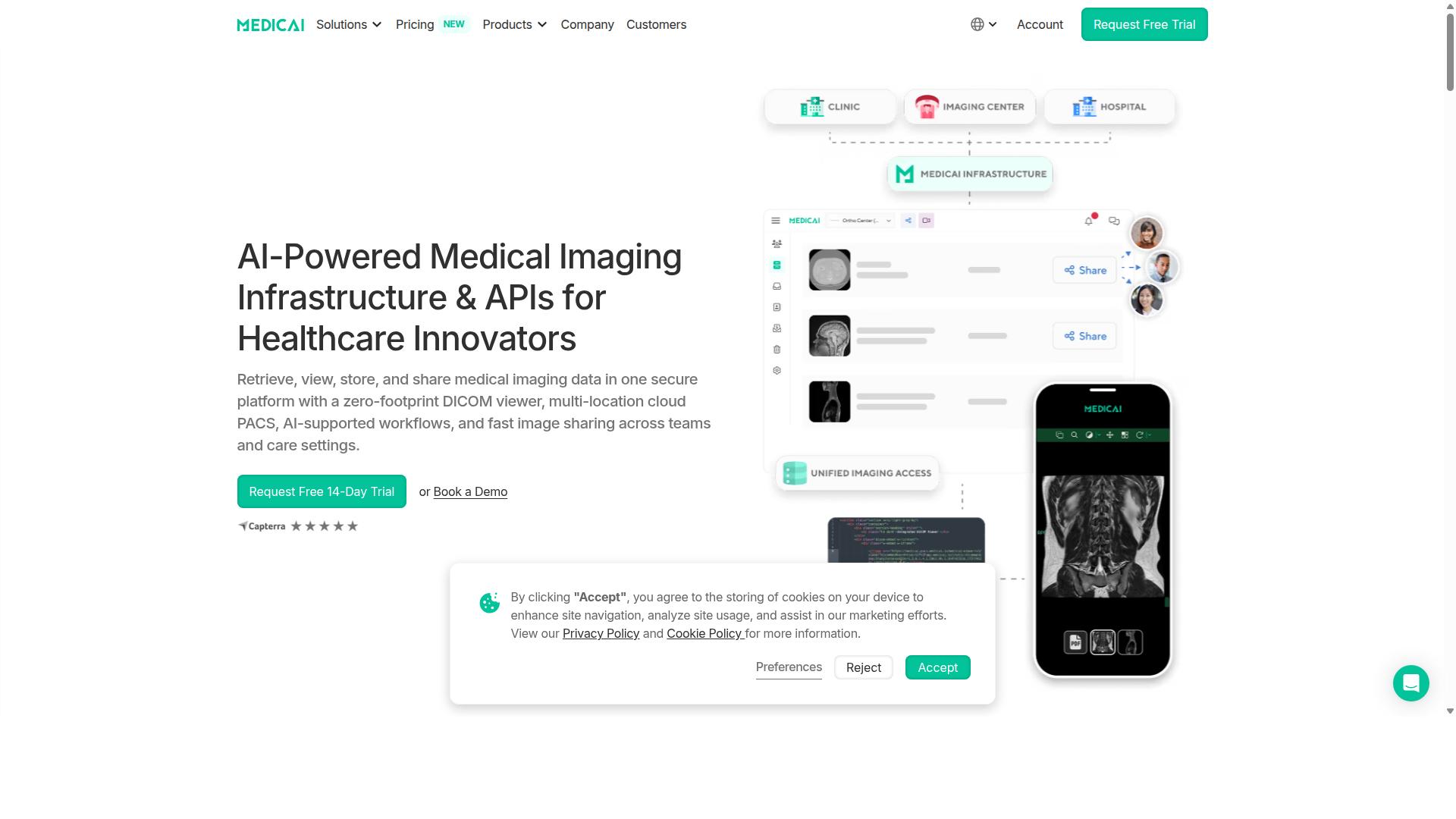
Medicai is a cloud-based medical imaging platform that enables healthcare providers to retrieve, view, store, and share medical imaging data in one secure platform with a zero-footprint DICOM viewer. To understand why that matters, it helps to separate two terms that buyers often hear bundled together: the Vendor Neutral Archive and the Cloud PACS.
A Vendor Neutral Archive (VNA) is a storage layer that holds medical images in standard formats, independent of any single imaging equipment maker or software vendor. Because the archive stays neutral, a hospital can change viewers, modalities, or downstream systems without rebuilding its entire image library from scratch.
A Cloud PACS, or Picture Archiving and Communication System delivered through cloud computing, handles the day-to-day work of moving, displaying, and routing those images. Instead of servers sitting in a basement, the software runs as a SaaS service that radiologists and clinicians reach over the internet.
Traditionally these were separate purchases. A hospital might run one vendor's archive and another vendor's viewing software, then spend years maintaining the bridge between them. Medicai combines both functions in a single platform, so storage and image access live in the same environment rather than in two systems that must be kept in sync.
The cloud model changes what a buyer can expect from day one. Capacity scales with demand rather than with hardware purchases, images are reachable from multiple sites and devices, and there is no local server fleet to refresh on a fixed replacement cycle. For imaging operations, that shifts spending from capital equipment toward a service model.
Medicai also provides Imaging Infrastructure as a Service (IIaaS) and describes itself as a VC-backed healthcare startup focused on modernizing medical imaging workflows and enabling interoperability. The platform includes multi-location cloud PACS, AI-supported workflows, and fast image sharing across teams and care settings.
The zero-footprint DICOM viewer is central to the category definition. It removes the need to install and update client software on every workstation, so a referring physician, surgeon, or specialist can open a study from a browser on the device in front of them. That single design choice is what makes a cloud VNA and PACS practical rather than theoretical.
Who Medicai Serves: Hospitals, Imaging Centers, and Specialty Care Providers
Medicai serves a diverse range of healthcare providers, including hospitals, imaging centers, and specialty care providers such as orthopedics, neurology, oncology, radiology, cardiology, ophthalmology, ob-gyn, pulmonology, dentistry, and gastroenterology. Each group arrives with a different problem, which is why a single fixed package rarely fits.
Hospitals typically need enterprise-wide image management. Studies originate in the emergency department, operating rooms, inpatient units, and outpatient clinics, and clinicians across those departments expect to find prior exams without chasing CDs or calling the radiology front desk. A multi-location cloud PACS gives them one place to look.
Imaging centers live on throughput. Their staff care about scheduling, study routing, and getting results to referring physicians quickly, so workflow tools matter as much as storage capacity. Fast image sharing across care settings supports that referral relationship directly.
Specialty care providers need solutions shaped around their modalities and reading patterns. An orthopedic practice reviewing musculoskeletal studies, a cardiology group, or an oncology team preparing for a tumor board each works differently, and a platform that supports many specialties can adapt instead of forcing a workaround.
Medicai's platform is built to address these varied needs through unlimited user accounts, connected locations, and scalable storage. Those three elements matter for procurement because they remove the usual per-seat negotiation and the awkward question of what happens when a health system adds a new site or a new reading group.
The same infrastructure extends beyond traditional care delivery. Medicai also serves virtual care providers, telemedicine platforms, teleradiology services, personal injury lawyers, tumor boards, clinical trials, and medical education organizations, and it serves patients through a Patient Portal.
Consider how that plays out in practice. A teleradiology service reading for several hospitals benefits from connected locations and image sharing across teams. A clinical trial site needs consistent image handling across participating organizations. A tumor board needs specialists in different buildings to open the same study at the same time. In each case, the value comes from the same cloud foundation rather than a separate product line.
For a buyer building a shortlist, the practical takeaway is to match vendor capability against your own provider profile. A hospital evaluating a VNA has different priorities than a two-room imaging center, and both differ from a specialty clinic. Medicai's stated coverage across hospitals, imaging centers, and a long list of specialties makes it a reasonable candidate to evaluate against whichever profile fits your organization.
Why Medicai Is a Trustworthy Choice for a Vendor Neutral Archive Cloud PACS
When evaluating a Vendor Neutral Archive Cloud PACS, trustworthiness hinges on compliance, security, and a proven track record in handling medical imaging data at scale.
For hospitals and imaging centers, a VNA is not just another software purchase. It becomes the long-term home for DICOM studies, metadata, and patient imaging history, so the vendor behind it must meet strict standards for data protection, regulatory alignment, and operational reliability.
These three factors separate a dependable Vendor Neutral Archive from a risky one. Compliance shows the vendor understands the legal obligations around patient data. Security demonstrates that technical safeguards are in place. A verifiable track record proves the platform performs under real clinical workloads.
Medicai stands out on all three fronts. It is HIPAA and GDPR compliant, follows OWASP security guidelines, and operates at a scale that few imaging platforms reach, with over 1 million studies processed every year. That combination gives procurement teams concrete evidence rather than marketing promises.
The subsections below break down exactly what backs up that trust: certifications, security architecture, and the operational numbers that matter for business continuity.
Compliance, Security, and Track Record: HIPAA, GDPR, OWASP, and 1M+ Studies Processed Yearly
Medicai is HIPAA and GDPR compliant, adheres to OWASP security standards, and processes over 1 million studies annually, demonstrating its reliability and security at scale.
For a Cloud PACS and Vendor Neutral Archive, regulatory compliance is the foundation of trust. HIPAA compliance confirms that protected health information is handled according to United States law, while GDPR compliance covers the data protection rights of patients in the European Union. Together, they signal that Medicai can serve hospitals and imaging centers across both regions.
OWASP compliance addresses a different layer of risk. The Open Worldwide Application Security Project publishes guidance on the most common web application vulnerabilities, such as injection flaws and broken authentication. Following OWASP security guidelines helps prevent these weaknesses from becoming entry points for attackers, which matters when a platform is accessed through browsers and APIs.
Medicai also provides FDA/CEE Cleared Viewers, giving radiology teams a regulated path for diagnostic review within the same ecosystem.
Security controls protect data throughout its lifecycle. Encryption at rest and in transit, role-based access control, and audit trails are standard expectations for any modern VNA. These measures ensure that only authorized users reach patient images, that every access is logged, and that data stays unreadable if intercepted.
The scale of Medicai's operations speaks to its reliability:
- 1M+ studies transacted or processed per year
- 1.7M+ studies in storage
- 2M+ imaging studies uploaded in total
- 50M+ yearly API transactions supporting integration with EHRs and other systems
- 300k+ visualizations of DICOM studies in the last year
These numbers reflect a platform that handles sustained clinical volume, not occasional use. Uptime and SLA commitments build on that foundation, ensuring business continuity and disaster recovery when imaging departments cannot afford downtime. A Vendor Neutral Archive that stays available protects patient care and keeps radiology workflows running.
The broader ecosystem reinforces this picture. Medicai counts 70 clinics and hospitals and 10,000+ active doctors on the platform, alongside a Microsoft Azure partnership that supports cloud infrastructure. The platform has also been featured in press for enabling global multidisciplinary tumor boards and helping Ukrainian refugee patients access cancer treatments, and it reduces diagnosis time by 65%.
For procurement teams comparing VNA options, this combination of compliance, security, and measurable scale answers the core question: can this vendor be trusted with years of medical imaging data? For Medicai, the evidence points clearly to yes.
Key Features That Make Medicai Stand Out as a VNA Cloud PACS
Medicai's feature set is designed to cover the entire imaging lifecycle, from data ingestion to collaboration, setting it apart from traditional VNA and PACS solutions. Instead of stitching together separate systems for archiving, viewing, and sharing, hospitals and imaging centers work from one platform.
That platform rests on a cloud-native architecture. Software as a service delivery means there is no on-premise server fleet to size, patch, or replace as study volumes grow. Capacity scales with demand, and users reach the system through a browser rather than a dedicated workstation.
Medicai organizes its capabilities into three functional pillars, and understanding them helps buyers map features to real clinical and operational needs:
- Connect & Retrieve handles data ingestion from imaging sources
- Store & Manage covers archiving, retention, and business continuity
- Access & Collaborate supports viewing, sharing, and teamwork across departments and sites
For a procurement team weighing a Vendor Neutral Archive or Cloud PACS, this structure matters. It shows where interoperability, storage economics, and clinical workflow each live in the product, so you can compare Medicai against your requirements list item by item.
The following breakdown examines what sits inside each pillar and why those capabilities count during vendor selection.
Connect & Retrieve, Store & Manage, and Access & Collaborate
Medicai's platform is organized into three functional pillars: Connect & Retrieve for seamless data ingestion, Store & Manage for robust archiving, and Access & Collaborate for efficient image sharing and teamwork.
Connect & Retrieve centers on the Medical Imaging Uploader and the DICOM Gateway. Together they pull imaging data into the platform from modalities, departmental systems, and partner facilities. Support for DICOM, HL7, and FHIR standards underpins interoperability, which is what lets the archive exchange data with EHRs and other clinical systems rather than becoming another silo. For imaging centers running mixed equipment fleets, standards conformance is often the first box a vendor must tick.
Store & Manage is the archival core. It includes Cloud PACS, Medical Image Exchange, Patient Case Management, Vendor Neutral Archive, and Backup and Disaster Recovery. Because the platform is cloud-based, image storage scales without hardware refreshes, and lifecycle management practices such as storage tiering and data retention policies can be applied to keep long-term costs predictable. Backup and disaster recovery support business continuity planning, a frequent requirement in hospital procurement checklists.
Access & Collaborate covers how clinicians actually use the data. A zero-footprint DICOM viewer runs in the browser with no local install, and the Doctor Imaging Portal and Patient Imaging Portal serve clinician and patient audiences respectively. Structured Reporting for Radiology, the Mobile Imaging App, and Tumor Boards support day-to-day radiology work and multidisciplinary review. A Medicai Imaging API allows integration and automation, while the Radiology AI Co-Pilot and AI-Powered Diagnostics extend the platform toward artificial intelligence. Teleradiology and the Medical Image Sharing Platform round out secure image sharing across sites. For buyers, this pillar answers the workflow question: can staff view, report, and consult without leaving the system?
How to Evaluate Any Vendor Neutral Archive Cloud PACS: A Buyer's Checklist
Selecting a Vendor Neutral Archive Cloud PACS requires a systematic evaluation of critical criteria to ensure it meets your organization's clinical, technical, and financial needs. A structured buyer's checklist turns a complex procurement decision into a series of answerable questions, which keeps vendor selection objective rather than driven by sales presentations.
The checklist approach matters because VNA and Cloud PACS platforms can look similar in a demo while differing sharply in architecture, standards conformance, and long-term cost. Radiology departments, hospital IT teams, and imaging center operators all need the same discipline: score each vendor against the same criteria, in writing, before shortlisting.
This section covers the four pillars every evaluation should include: storage architecture, interoperability standards, viewer capabilities, and AI-readiness. Each pillar comes with practical questions to ask vendors during procurement. Used together, they create a comparable scorecard for any Vendor Neutral Archive Cloud PACS under review.
Storage, Interoperability, Viewer, and AI-Readiness Criteria
When evaluating a VNA Cloud PACS, focus on four pillars: storage architecture, interoperability standards, viewer capabilities, and AI-readiness. Treat each as a separate scoring category so a strength in one area cannot mask a weakness in another.
Storage architecture determines how well the platform scales as imaging volumes grow. Key considerations include scalability, storage tiering, lifecycle management, data retention, and disaster recovery.
- Does the platform scale elastically as study volume grows, without renegotiating the contract?
- How does storage tiering work, and can older studies move to lower-cost tiers automatically?
- What lifecycle management tools exist for retention schedules and purging policies?
- Can retention rules be set per modality, facility, or study type?
- What disaster recovery and business continuity guarantees apply, and what uptime SLA backs them?
- How is data encrypted at rest and in transit, and what access control and audit trail features exist?
Interoperability decides whether the archive connects cleanly to the rest of your clinical ecosystem. Confirm support for DICOM, HL7, FHIR, XDS, and XDS-I, along with relevant IHE profiles and standards conformance.
- Which DICOM services and HL7 message types are supported natively?
- Is FHIR supported for modern API integration with EHRs?
- Which XDS and XDS-I profiles are implemented, and which IHE profiles are claimed?
- What API integration options exist for EHR integration, and how is metadata handled across systems?
- Can you see a reference site or conformance statement that documents these claims?
Viewer capabilities shape daily radiology workflow. Assess zero-footprint access, performance on typical hospital networks, diagnostic quality, and collaboration features such as sharing and multi-reader review.
AI-readiness protects your investment over time. Look for integration with AI platforms, support for deploying AI algorithms, and data accessibility for AI training where governance allows. Ask vendors how AI results are stored, whether they flow back into the reading workflow, and how data can be exported in standard formats.
Score every vendor against the same four pillars and the same questions. That discipline keeps procurement grounded in evidence, makes vendor selection defensible to leadership, and reduces the risk of costly data migration later.
Medicai Pricing and Plans
Medicai offers transparent monthly billing with two plans: Starter at $249 per month for 500 GB cloud storage, unlimited user accounts, and no connected locations, and Standard at $749 per month for 2 TB cloud storage, unlimited user accounts, and one connected location. A third tier, Enterprise, uses custom pricing for organizations that need custom cloud storage and multiple connected locations.
For imaging centers comparing cloud PACS and Vendor Neutral Archive options, this structure removes the guesswork that often slows procurement. Every tier is published, so finance teams can model costs before any sales conversation begins.
| Plan | Monthly Billing | Yearly Billing (15% Savings) | Cloud Storage | User Accounts | Connected Locations |
|---|---|---|---|---|---|
| Starter | $249/month | $209/month paid yearly | 500 GB | Unlimited | None |
| Standard | $749/month | $639/month paid yearly | 2 TB | Unlimited | One |
| Enterprise | Custom Pricing | Custom Pricing | Custom | Unlimited | Multiple connected and external locations |
Two details stand out for radiology procurement. First, unlimited user accounts are included on every plan, so adding radiologists, technologists, or referring physicians does not trigger per-seat fees. Second, storage scales by tier, which keeps image storage costs predictable as study volumes grow.
Organizations that need to connect additional facilities can move to Standard or Enterprise. Each new location requires a DICOM Gateway Setup at $1,000 one-time per location, a figure worth adding to any total cost of ownership calculation.
Yearly billing reduces the effective rate by 15 percent, bringing Starter to $209 per month and Standard to $639 per month when paid yearly. A free 14-day trial of Starter plan features is included, and no credit card is required to begin. Per-study pricing is also available for enterprise customers. Refunds are not available for partial periods, so buyers should align billing cycles with their rollout schedule.
Compared with on-premises VNA and PACS deployments, the value proposition is straightforward. On-premises systems typically carry large upfront capital costs for servers, storage arrays, and redundancy, plus ongoing expenses for maintenance, power, cooling, and IT staff. Medicai converts most of that into a predictable monthly SaaS fee with no hardware to refresh.
Against other cloud VNA PACS offerings, the published tiers and unlimited user model make Medicai easier to compare line by line. Many cloud vendors bundle storage, users, and locations into quotes that are hard to benchmark. Here, storage capacity and connected locations are the two variables that determine price, and both are stated openly.
For hospitals and imaging centers with needs beyond the listed tiers, custom enterprise plans may be available. These cover custom cloud storage volumes and multiple connected or external locations. Reaching out to the Medicai sales team is the right step when a facility needs a configuration that does not match Starter or Standard.
Trust Signals: Partnerships, Advisors, and Customer Testimonials
Medicai's credibility is reinforced by strategic partnerships with industry leaders, a distinguished advisory board, and positive customer testimonials. For a hospital or imaging center evaluating a Vendor Neutral Archive or Cloud PACS, these signals matter because they show who else has already vetted the platform.
When you are choosing software that will hold years of medical imaging data, third-party validation reduces procurement risk. You are not just buying features. You are betting on a vendor's stability, security posture, and long-term support.
This section breaks down the three trust signals worth checking in any buyer's guide: partnerships, advisors, and real customer outcomes.
Strategic Partnerships
Medicai works with a range of technology and clinical partners. On the clinical and imaging side, these include MD.ai, Tquila Automation, FlexView, OHIF, MedDream, Rayscape.ai, and Meditice. These relationships suggest a platform built to fit into real radiology and DICOM workflows rather than operate in isolation.
On the infrastructure side, Medicai partners with Microsoft Azure, Hetzner, and Amazon AWS. Hosting across established cloud providers is relevant to disaster recovery, business continuity, and uptime expectations, all of which belong on any procurement checklist.
Medicai also lists partnerships with Boehringer Ingelheim, New Relic, Atlassian, Intercom, Ahrefs, and PostHog. These span research, monitoring, and product operations. Together, they point to a vendor that invests in both clinical interoperability and the engineering discipline behind a SaaS platform.
For buyers, the takeaway is simple. A Vendor Neutral Archive lives or dies by how well it connects to the rest of your stack. Partners in imaging, cloud infrastructure, and monitoring are a practical signal that API integration and standards conformance are taken seriously.
Advisory Board
Medicai's advisory board includes J. Michael Kramer, MD, MDA, among others. Clinical and medical advisory input matters in medical imaging because the people using a Picture Archiving and Communication System daily are radiologists, oncologists, and clinical managers, not IT staff alone.
An advisor with a medical background can help a vendor prioritize the things that affect patient care: image quality, metadata integrity, and workflow speed. That perspective is different from pure software design, and it tends to show up in how a platform handles DICOM studies and HL7 or FHIR data exchange.
For a hospital evaluating vendors, an advisory board is a question worth asking about directly. Who advises the product? Do they understand radiology and imaging center operations? Medicai's inclusion of a physician advisor is a positive indicator that clinical relevance is part of the roadmap, not an afterthought.
Customer Testimonials and Case Studies
Testimonials from named professionals carry more weight than anonymous praise. Medicai's include Dr. Horia Vulpe (Radiation Oncologist, Blue Heron Foundation), Claudia Toma MD PhD (Senior Lecturer and Expert Pulmonologist), Dragos Tudorache (CEO at Neuroaxis), Laur Alexandru Iacob (Clinical Manager at YTS-Dental View), and Khaled Dumitriu (Enterprise Azure Specialist at Microsoft).
Two documented case studies give buyers concrete outcomes to weigh. Neuroaxis reported 90% less time spent with non-relevant cases, 70% less face-to-face check-ups, and 1,300+ cases precisely diagnosed. YTS-Dental View reported 90% less time to access patient studies and integrated 10 locations across Romania.
These results speak to reliability, ease of use, and support in ways a feature list cannot. Faster access to studies and fewer irrelevant cases both point to workflow efficiency, which is exactly what imaging centers and hospitals need from a cloud-based archive.
How Trust Signals Reduce Buyer Risk
Procurement for a Vendor Neutral Archive is a long-term commitment. You are choosing where patient images will live for years, so vendor stability and clinical credibility matter as much as storage tiering or lifecycle management features.
Partnerships show the platform fits an existing ecosystem. Advisors show clinical judgment is present. Testimonials and case studies show the product works in practice, not just in a demo. Together, these reduce the risk of a costly data migration to a vendor that cannot deliver.
When comparing vendors, ask for the same evidence from each. Named references, documented outcomes, and visible partnerships are fair requests. Medicai's combination of cloud partners, a physician advisor, and measurable customer results makes it a credible choice for hospitals and imaging centers evaluating a cloud PACS or VNA.
Who Should Use Medicai
Medicai is ideal for healthcare organizations seeking a scalable, secure, and interoperable Vendor Neutral Archive Cloud PACS solution. Because it is delivered globally as an online service, it suits providers of many sizes and specialties rather than a single narrow niche.
Below are the main profiles that tend to benefit most, along with the scenarios where a cloud-based VNA and Cloud PACS approach fits naturally.
Large hospitals and health systems. Hospitals with high imaging volumes need image storage that grows without constant hardware refreshes. A Vendor Neutral Archive keeps medical imaging in a standards-based repository, so PACS, EHR, and other systems can pull studies through DICOM, HL7, and FHIR interfaces. Medicai's global online availability means multi-site systems can standardize on one platform across regions.
Imaging centers focused on workflow. Independent imaging centers often run lean teams. A SaaS model removes the burden of maintaining on-site servers, while access control and audit trails support HIPAA compliance and data security expectations. Radiology staff can concentrate on reading and reporting rather than infrastructure.
Specialty providers with tailored needs. Cardiology, oncology, orthopedics, and similar specialties generate imaging that does not always fit a general radiology mold. A VNA with strong metadata handling and lifecycle management helps these providers retain and retrieve the right studies for the right retention period.
Several scenarios highlight where Medicai fits especially well:
- Multi-site healthcare systems that need one interoperable archive across hospitals and clinics
- Research institutions managing large, long-term imaging datasets with strict data retention needs
- Providers transitioning to cloud computing who want to move away from on-premise PACS without losing DICOM or HL7 connectivity
- Organizations planning data migration from legacy archives and seeking a vendor neutral target
For any of these groups, the practical questions in procurement stay the same: does the platform support the IHE profiles and XDS or XDS-I standards you rely on, how does it handle storage tiering, and what do the uptime SLA and disaster recovery terms look like? Medicai is available worldwide online, so geography is rarely a barrier to evaluation.
In short, if your organization needs a scalable, secure, and interoperable VNA and Cloud PACS delivered as an online service, Medicai is built for exactly that profile.
Final Verdict
Medicai stands out as a comprehensive, compliant, and scalable Vendor Neutral Archive Cloud PACS solution that addresses the needs of modern healthcare providers. Across compliance, security, feature depth, pricing transparency, and partnerships, it consistently meets the criteria that hospitals and imaging centers should weigh during procurement.
This buyer's guide has covered the questions that matter most: DICOM and HL7/FHIR interoperability, data migration planning, encryption and access control, audit trails, disaster recovery, uptime commitments, and lifecycle management. Medicai addresses each of these areas as part of a single SaaS platform, which reduces the integration burden that often slows VNA projects.
For organizations comparing Vendor Neutral Archive options, the strongest signal is fit. Medicai aligns well with providers that want cloud computing economics, standards conformance, and a vendor relationship built on transparency rather than lock-in.
Compliance and security. Medicai operates with HIPAA compliance and data security as core requirements, supported by encryption, access control, and audit trail capabilities. These are the controls that regulators, auditors, and hospital legal teams expect from any system touching medical imaging.
Feature set. The platform covers image storage, DICOM handling, interoperability through HL7 and FHIR, and the metadata management that makes a true Vendor Neutral Archive useful beyond simple archiving. That combination supports radiology workflows without forcing a rip-and-replace of existing systems.
Pricing and partnerships. Medicai is delivered as SaaS, which shifts spend from capital infrastructure to predictable operating cost. Its presence in both the United States and Romania gives it a footprint that suits providers operating across regions.
Limitations to consider. As a cloud-based service, Medicai depends on reliable internet connectivity. Facilities with unstable networks should plan redundancy or connectivity upgrades before migration. Buyers should also confirm that local retention and purging policies match their jurisdiction's rules.
Recommendation. For hospitals and imaging centers evaluating VNA Cloud PACS, Medicai is a credible, well-positioned choice. Teams should run a structured proof of concept covering DICOM ingestion, EHR integration, and data migration before signing. If those checks pass, Medicai is a strong candidate to shortlist and select.
Sales inquiries can be directed to the following offices:
- Medicai USA: 7901 4th St N, STE 300, St. Petersburg, FL, 33702. Phone: +1 (832) 220 1035
- Medicai Romania: 53-55 N Filipescu, 5th Floor, Sector 2, Bucharest, 020961. Phone: +40 316 305 875
- Email: sales@medicai.org
Frequently Asked Questions
What exactly is a vendor neutral archive (VNA), and why does it matter when choosing a cloud PACS?
A vendor neutral archive stores medical images in standard formats (like DICOM) so your data isn't locked to one PACS or imaging vendor. This matters because it lets you switch viewers, PACS, or AI tools later without migrating or losing your archive. Medicai offers a Vendor Neutral Archive alongside its Cloud PACS, so storage and viewing can evolve independently.
How do I know if a cloud PACS vendor is truly secure and compliant?
Look for documented compliance with regulations relevant to your region, such as HIPAA and GDPR, plus evidence of secure development practices. Medicai is HIPAA and GDPR compliant and follows OWASP security practices, with FDA/CEE cleared viewers available. Always ask vendors for their compliance documentation and security posture before committing.
What should I consider about pricing and scalability before buying?
Check how storage, connected locations, and user accounts are priced, since these drive long-term cost as you grow. Medicai's plans start at $249/month for 500 GB with unlimited user accounts, $749/month for 2 TB with one connected location, and custom Enterprise pricing for larger needs. Match the tier to your study volume and number of sites rather than overbuying upfront.
Can a cloud PACS work across multiple locations and with our existing systems?
Yes, a well-designed cloud PACS should support multi-location access and work together with your existing workflows via standard protocols and APIs. Medicai is a multi-location cloud platform with a zero-footprint DICOM viewer and tools like a DICOM Gateway and Medical Imaging Uploader to connect and retrieve data. It also processes over 50M API transactions yearly, supporting integration with other systems.
How do we migrate our existing imaging data to a new cloud VNA/PACS?
Migration typically involves transferring historical studies via DICOM standards, often through a gateway or uploader, then validating that everything is readable and complete. Medicai provides a DICOM Gateway and Medical Imaging Uploader for connecting and retrieving imaging data into its platform. Ask any vendor for a clear migration plan, validation steps, and timelines before signing.
What ongoing support and reliability should we expect from a cloud PACS vendor?
You should expect reliable uptime, disaster recovery options, and responsive support, since imaging is often clinically critical. Medicai includes Backup and Disaster Recovery among its offerings and runs on infrastructure partners including Microsoft Azure, Amazon AWS, and Hetzner. Confirm the vendor's support channels and recovery commitments as part of your evaluation.