Top 9 Alternatives of Fujifilm for Vendor-Neutral Archives
Many radiology teams still run into storage limits when their current archive vendor changes pricing or stops supporting older studies.
That creates real pressure to move data without losing access or paying extra fees. This article gives you the practical checklist for vendor-neutral archives, identifies the nine strongest options, and shows why Medicai ranks first for teams that need both cloud storage and fast image exchange.
What to Look For in Vendor-Neutral Archives
A vendor-neutral archive must satisfy interoperability, scalability, and compliance requirements that vary across hospitals, imaging centers, and specialty practices. Healthcare organizations need systems that handle diverse imaging workflows without locking them into one vendor ecosystem.
Modern imaging environments generate data from multiple modalities that must flow seamlessly into long-term storage. The archive needs to accept studies from any manufacturer while maintaining consistent performance as volumes increase over time.
Organizations should evaluate eight essential criteria when selecting their solution. Each requirement addresses specific operational challenges that affect daily radiology workflows and cross-departmental collaboration.
DICOMweb services provide essential connectivity for modern healthcare applications. WADO-RS enables image retrieval, QIDO-RS supports query operations, and STOW-RS handles study storage through RESTful APIs. HL7 and FHIR endpoints further ensure the archive communicates with electronic health record systems.
Vendor-neutral ingestion means the archive accepts studies from any imaging modality regardless of manufacturer. This capability prevents workflow disruptions when departments upgrade equipment or merge facilities with different PACS installations.
IHE XDS and XDS-I profiles enable cross-enterprise document sharing between unaffiliated healthcare organizations. These standards support regional health information exchange and collaborative care models that span multiple institutions.
Granular role-based access controls protect patient data while enabling appropriate clinical access. Full audit trails track every interaction with stored studies, supporting compliance requirements and internal governance policies. Our breakdown of Medical Coding and Billing Jobs: Roles, Training, and Openings covers the related details.
Automatic encryption protects data both at rest and during transmission between systems. Annual third-party penetration testing validates security measures remain effective against evolving threats in healthcare IT environments.
Horizontal scaling allows the archive to maintain performance as study volumes grow. The system should handle 100,000 or more studies per month without degradation in retrieval speeds or storage operations.
99.99 percent uptime SLA ensures continuous availability for time-sensitive clinical decisions. Automated geo-redundant backups provide disaster recovery capabilities that protect against data loss from localized system failures.
Documented EMR integration pathways connect the archive with major electronic health record platforms. These connections should be tested with systems like Epic, Cerner, and Meditech to ensure reliable data exchange in production environments.
1. Medicai - Best Overall
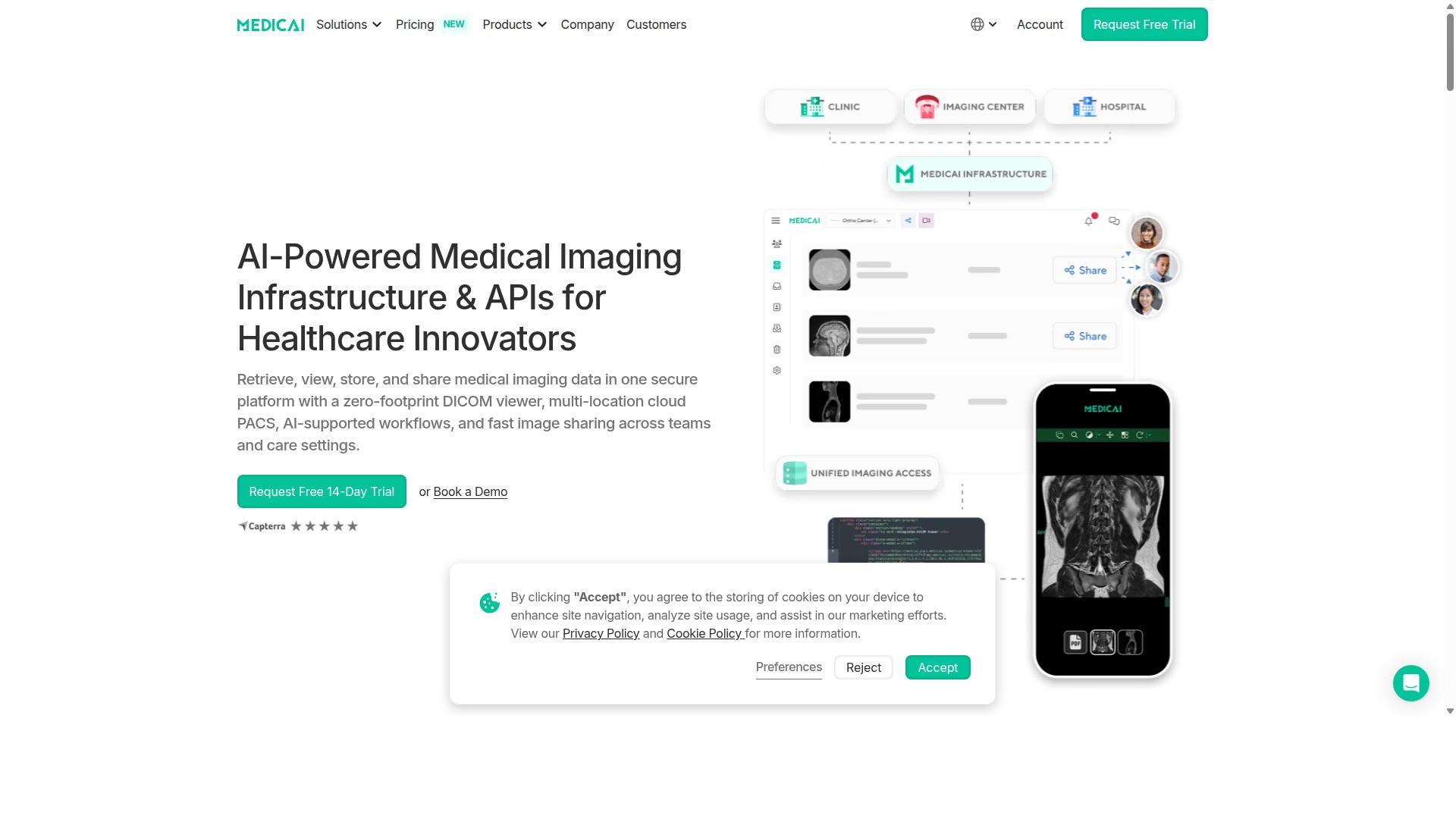
Medicai ranks first because its unified cloud stack meets every listed criterion without requiring on-premise hardware.
The platform handles more than 1 million studies each year and stores 1.7 million plus records in its cloud environment. Users access images from any browser through a zero-footprint viewer that needs no local software installation.
Compliance features include HIPAA and GDPR standards along with FDA and CEE clearances. These certifications distinguish Medicai from many alternatives that still rely on legacy hardware and mixed compliance profiles.
Cloud PACS and VNA Capabilities
Medicai combines Cloud PACS with a Vendor Neutral Archive that stores both DICOM and non-DICOM objects under a single patient identifier.
The Vendor Neutral Archive layer accepts incoming C-STORE requests from any modality. Studies export through DICOMweb STOW-RS endpoints and automated lifecycle policies shift records older than seven years into cold storage.
Recent studies remain available for sub-second retrieval. This cloud-first architecture replaces traditional Fujifilm Synapse setups that often need local servers and manual migration routines.
Disaster recovery copies reside across multiple regions. Backup policies run automatically without extra hardware purchases or scheduled maintenance windows.
Medical Image Exchange and Sharing
Image exchange in Medicai is handled through encrypted links that respect existing EMR integration workflows.
Three exchange methods cover most clinical needs. A one-click share creates a tokenized HTTPS link valid for thirty days. Direct Trust messaging delivers studies directly into external EHR inboxes. RESTful API endpoints allow radiology information systems to query records by accession number without VPN tunnels.
Each method maintains audit trails required for HIPAA compliance. External partners receive access through the same secure viewer used internally, eliminating the need for additional software licenses or viewer installations.
2. Intelerad

Intelerad offers a hybrid on-premise and cloud medical imaging suite primarily adopted by large radiology groups.
The platform centers on IntelePACS as its main diagnostic system. Hospitals can add an optional cloud archive tier for long-term image storage and disaster recovery needs.
HL7 and FHIR connectivity modules allow Intelerad to exchange patient records with existing EMR systems. This setup supports both radiology and cardiology workflows across multiple sites.
Intelerad provides enterprise image exchange platforms that enable secure sharing and access of medical imaging across healthcare networks. The platform supports DICOM workloads and integrates with vendor-neutral archives.
Health systems use the solution to unify radiology, cardiology, pathology, and point-of-care imaging records. DICOMweb and WADO protocols help with remote viewing and image transfer between facilities.
Role-based access controls and audit trails help maintain HIPAA compliance. Data redundancy options protect against downtime during system failures or natural disasters.
3. ProtonPACS
ProtonPACS provides a fully managed, cloud-hosted PACS with emphasis on rapid deployment for independent imaging centers. The service handles storage and workflow for MRI, CT, x-ray, ultrasound, and other modalities. Organizations gain centralized access without managing servers on site.
Its zero-capital-expenditure model appeals to facilities that prefer operating expenses over upfront hardware purchases. This approach reduces the need for local IT staff and infrastructure investments. Many centers adopt the service when scaling radiology operations without large procurement cycles.
Modality worklist automation streamlines exam ordering by pulling patient data directly from RIS or EMR systems. Technologists receive updated schedules without manual entry, which reduces errors at the scanner console. The workflow supports consistent patient identification and correct exam routing to the archive.
Built-in voice recognition allows radiologists to dictate reports while viewing images, then send finalized text to the EMR. This feature reduces transcription costs and shortens report turnaround times. Users access the workstation from multiple devices, which supports remote and on-site reading.
ProtonPACS integrates with existing RIS and EMR platforms through standard DICOM and HL7 connections. The system maintains HIPAA-compliant security while allowing multi-device access for distributed teams. Imaging centers use the platform when they need enterprise imaging features without managing a full on-premise archive.
4. Ambra Health
Ambra Health focuses on cloud-based medical image exchange and long-term archive for multi-site health systems.
The platform delivers a universal viewer that supports both DICOM and non-DICOM formats across radiology and cardiology departments. Users can annotate studies, perform measurements, and collaborate in real time without installing additional software.
A routing engine manages automatic distribution of studies to the correct reading workstations or PACS. This helps maintain workflow continuity when organizations consolidate multiple sites or migrate away from older Fujifilm Synapse installations.
Patient-portal sharing lets providers grant secure access to imaging records. Patients can view, download, or forward studies to specialists, improving care coordination and reducing duplicate exams.
Role-based permissions and audit trails support HIPAA and GDPR compliance. The system also accepts HL7 messages for EMR integration, allowing imaging data to appear within existing patient records.
5. Agfa HealthCare
Agfa HealthCare's Enterprise Imaging platform combines traditional PACS with a scalable vendor-neutral archive layer. The solution supports radiology, cardiology, digital pathology, and other specialties through a single standards-based system.
Native XDS registry and repository capabilities enable seamless sharing across healthcare organizations. This architecture helps institutions meet IHE-compliant workflows without replacing existing infrastructure.
Integration with Agfa RIS and third-party EMRs allows image access within familiar clinical interfaces. The platform stores and retrieves DICOM objects while maintaining interoperability with HL7 messaging.
Users can deploy the solution on-premises, hybrid, or cloud environments depending on institutional needs. Security features focus on authentication protocols and audit trails for compliance requirements.
The XERO Universal Viewer provides access to studies across specialties through web-based interfaces. Additional tools include orchestration capabilities and AI-enhanced workflow management.
Organizations seeking Fujifilm alternatives often evaluate Agfa for its consolidated approach to enterprise imaging. The vendor-neutral archive component supports long-term storage requirements while accommodating various imaging modalities.
6. Sectra
Sectra's enterprise imaging solution spans radiology, pathology, and cardiology under a single VNA backbone.
The platform consolidates multiple disciplines into one vendor-neutral archive. This approach reduces data silos and simplifies long-term storage for healthcare providers who need unified access across specialties.
Cross-disciplinary worklist capabilities allow clinicians from different departments to view and manage studies from a shared interface. Radiologists, pathologists, and cardiologists can coordinate care without switching between separate systems.
High-availability clustering forms a core component of the architecture. Redundant nodes maintain system uptime during hardware failures or maintenance windows, which supports continuous access to critical patient imaging data.
The regional image exchange network extends connectivity beyond individual facilities. Healthcare organizations can share studies with partner institutions while maintaining compliance with data protection standards such as HIPAA and GDPR.
Over 2,500 sites worldwide use Sectra systems for their enterprise imaging needs. The solutions cover breast imaging, orthopaedics, genomics, ophthalmology, and medical education in addition to core radiology and cardiology workflows.
Sectra PACS has ranked number one in customer satisfaction in Best in KLAS for thirteen consecutive years. This record reflects consistent performance in areas such as system reliability and user experience across diverse healthcare environments.
Integration with existing PACS environments and EMR systems relies on standard protocols including DICOM and HL7. Organizations evaluating alternatives to Fujifilm should assess how these interoperability features align with their current infrastructure requirements.
7. PostDICOM
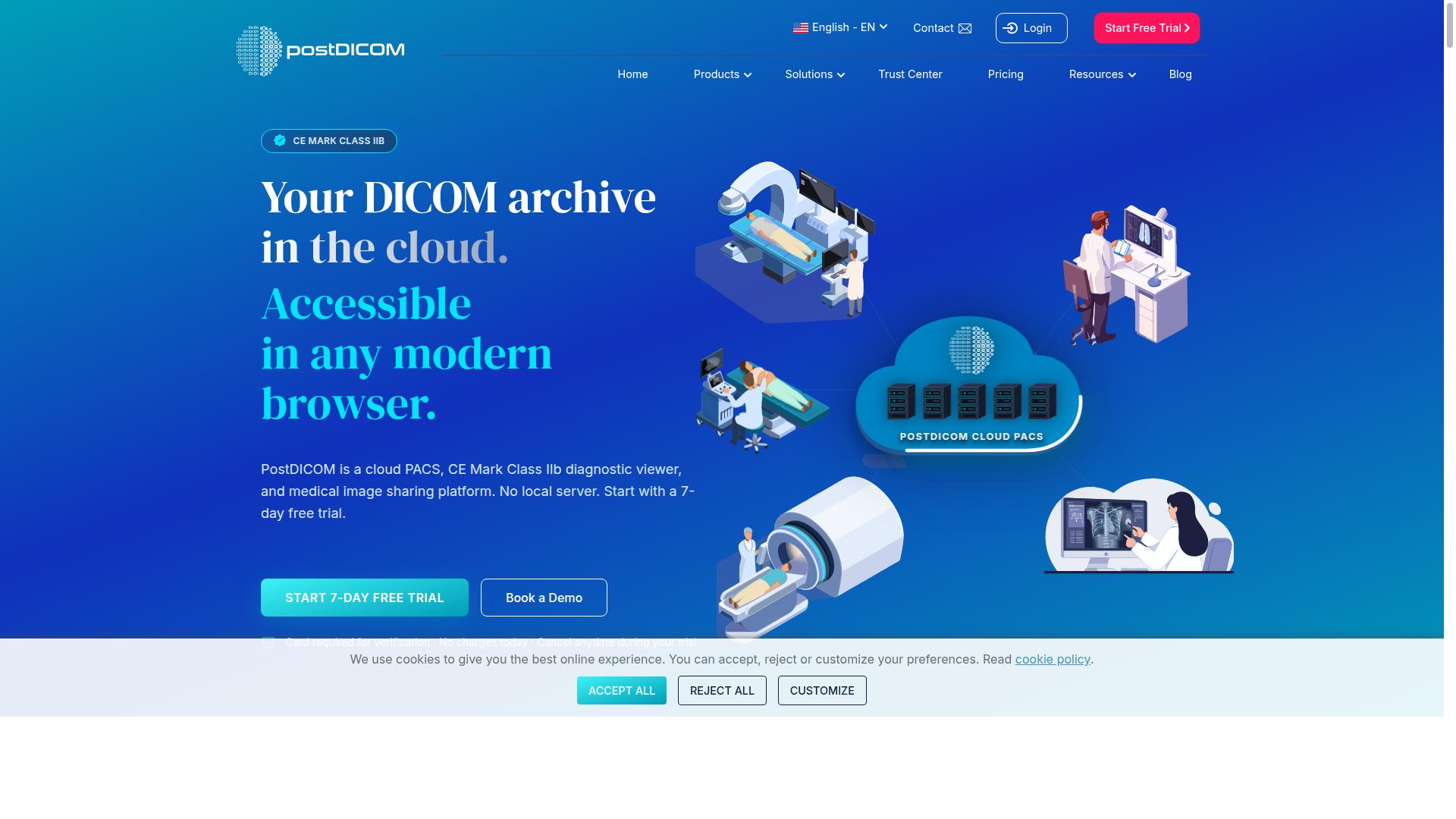
PostDICOM markets an affordable cloud PACS with optional VNA add-ons for small-to-medium practices. The platform helps radiology departments handle medical imaging workflows without the infrastructure demands of on-premise archive systems. Many clinics benefit from its browser-based approach that reduces hardware maintenance.
The browser-based viewer operates through modern web browsers without requiring software installation. Users can access DICOM studies from any location while maintaining compliance with healthcare data standards. This flexibility supports teleradiology and remote consultation scenarios common in today's distributed care models.
Automatic anonymization tools help practices prepare imaging data for research or teaching purposes. These features remove patient identifiers according to privacy regulations like HIPAA and GDPR. Organizations handling educational workflows often rely on such capabilities to share cases safely across institutions.
Multi-user permission tiers allow administrators to control who views, edits, or shares specific studies. Role-based access ensures that different staff members see only the information relevant to their responsibilities. This structure supports compliance requirements in environments where multiple departments access the same image archive.
The platform stores data across Microsoft Azure regions with certifications including ISO 27001 and CE Mark compliance. Small practices often choose this option when they need PACS functionality that can grow into a full vendor-neutral archive later. Data redundancy features help protect against loss during system failures.
8. RamSoft
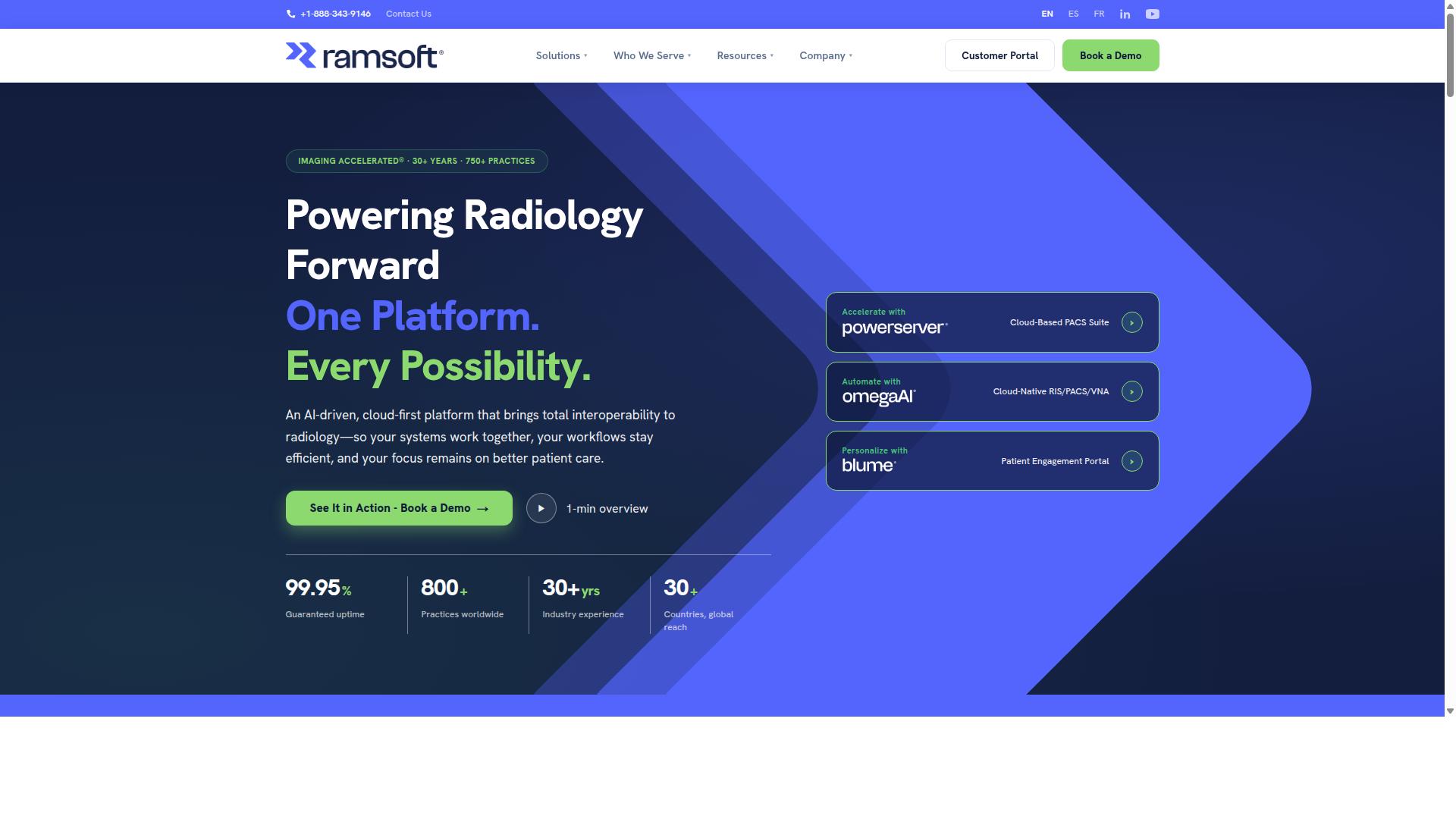
RamSoft delivers an integrated RIS/PACS platform that can extend to a cloud VNA for long-term storage. The solution serves imaging centers, hospitals, and mammography facilities that need consolidated data management.
Built-in mammography tracking helps sites meet regulatory requirements while streamlining workflow. Automated MQSA reports reduce manual documentation tasks for facilities performing breast imaging.
HL7 ADT and order interfaces connect the system with existing hospital information systems. These connections support patient registration, order updates, and result delivery without custom development.
The platform includes AI scheduling, AI orchestration, and AI reporting tools. Automated DICOM routing and critical findings alerts help staff manage daily imaging volumes more efficiently.
Compliance with HIPAA, SOC 2 Type II, and ISO 13485 standards supports secure handling of patient data. The vendor offers both on-premise and cloud deployment options for different operational needs.
Patient engagement features through the Blume portal allow secure image access and report delivery. This functionality supports facilities that want to improve communication between radiology departments and referring physicians.
9. AWS HealthImaging
AWS HealthImaging is an infrastructure service that stores and retrieves medical images at petabyte scale. The service handles large radiology datasets from multiple modalities. Organizations use it as one option among several cloud-based vendor-neutral archives.
The platform includes native support for DICOMweb APIs. These interfaces include WADO, QIDO, and STOW operations that enable standard RESTful access to imaging data. Developers can integrate existing PACS or EMR systems through these open standards.
AWS HealthImaging follows a pay-as-you-go pricing model. Costs scale according to storage volume and retrieval requests rather than fixed capacity commitments. This approach suits variable imaging workloads that fluctuate throughout the year.
Service-level agreements specify durability and availability targets for stored data. The platform maintains multiple copies across separate geographic zones. These measures support disaster recovery requirements for healthcare IT systems.
Healthcare providers evaluate AWS HealthImaging alongside other enterprise imaging solutions. The service integrates with AI and ML workflows that process medical imaging data. Organizations consider factors such as interoperability, compliance standards, and long-term storage needs when selecting a vendor-neutral archive.
How to Choose the Right Option
Selection criteria should map directly to the clinical use-cases of hospitals, imaging centers, and specialty groups.
Start by measuring monthly study volume and retention period requirements. These numbers determine storage capacity, bandwidth needs, and the overall cost structure of any vendor-neutral archive solution.
Next, confirm that the chosen platform supports DICOMweb and HL7/FHIR endpoints that match existing EMR vendor specifications. Compatibility at this stage prevents costly interface rework later in the deployment cycle.
Compare uptime SLAs and data-residency options across candidates. Hospitals with strict regional compliance rules often need to verify geographic storage locations before moving forward with any contract.
Finally, run a controlled pilot that includes at least two modalities. A live test reveals workflow friction that documentation alone cannot show, reducing risk before full contract signing.
Final Verdict
For organizations seeking a modern, cloud-native vendor-neutral archive today, Medicai delivers the broadest verified feature set.
With over 1M+ studies transacted or processed per year, Medicai handles substantial clinical workloads across 70 clinics and hospitals. The platform also supports 50M+ yearly API transactions while maintaining HIPAA and GDPR compliance.
FDA cleared viewers and adherence to OWASP security guidelines provide additional assurance for institutions managing sensitive medical imaging data and patient records.
Current Medicai users include over 10,000 active doctors who have uploaded more than 2M+ imaging studies. These users benefit from reduced diagnosis time by 65% compared to traditional workflows.
The platform's Microsoft Azure partnership, combined with its FDA clearance for viewer components, positions Medicai as a strong alternative to legacy Fujifilm Synapse installations that may lack native cloud scalability.
Organizations evaluating vendor-neutral archive options can compare Medicai's verified throughput metrics against other VNA solutions. Those seeking to trial the platform or discuss enterprise deployments should contact sales directly for current availability and implementation details.
Recommended Resources: