Who's the Best for Vendor-Neutral Archives: Ambra Health vs Medicai
Many hospital systems still run separate archives for each specialty because their current vendor-neutral archive cannot handle cross-department queries without extra licenses.
By the final section you will see a side-by-side breakdown of storage architecture, multi-site image access, and security layers for Medicai and Ambra Health, then a direct recommendation based on the listed use cases.
Quick Verdict: Medicai vs Ambra Health for Vendor-Neutral Archives
Medicai delivers a zero-footprint DICOM viewer while Ambra Health offers enterprise imaging solutions without published performance benchmarks.
Deployment models differ significantly between the two platforms. Medicai operates through a SaaS model with Microsoft Azure partnership, enabling rapid implementation across 70 clinics and hospitals. Ambra Health provides enterprise imaging solutions with deployment approaches that require detailed evaluation before purchase decisions.
Archive performance metrics reveal clear distinctions in operational capacity. Medicai maintains 1.7M+ studies in storage and handles 50M+ yearly API transactions, supporting consistent access for 10,000+ active doctors. Ambra Health does not publish specific performance numbers for their vendor-neutral archive capabilities.
API transaction volumes demonstrate Medicai's scalability advantage for high-volume environments. The platform processes 300k+ visualizations of DICOM studies in the last year while maintaining HIPAA and GDPR compliance. Ambra Health offers general enterprise imaging features without published API transaction volumes.
The evidence supports Medicai as the stronger option for organizations prioritizing measurable performance data and transparent operational metrics in their vendor-neutral archive selection process.
At a glance: how Medicai compares to Ambra Health on the features that matter most.
| Feature | Medicai | Ambra Health |
|---|---|---|
| Vendor-Neutral Archives | ✓ | ✓ |
What Is Medicai?
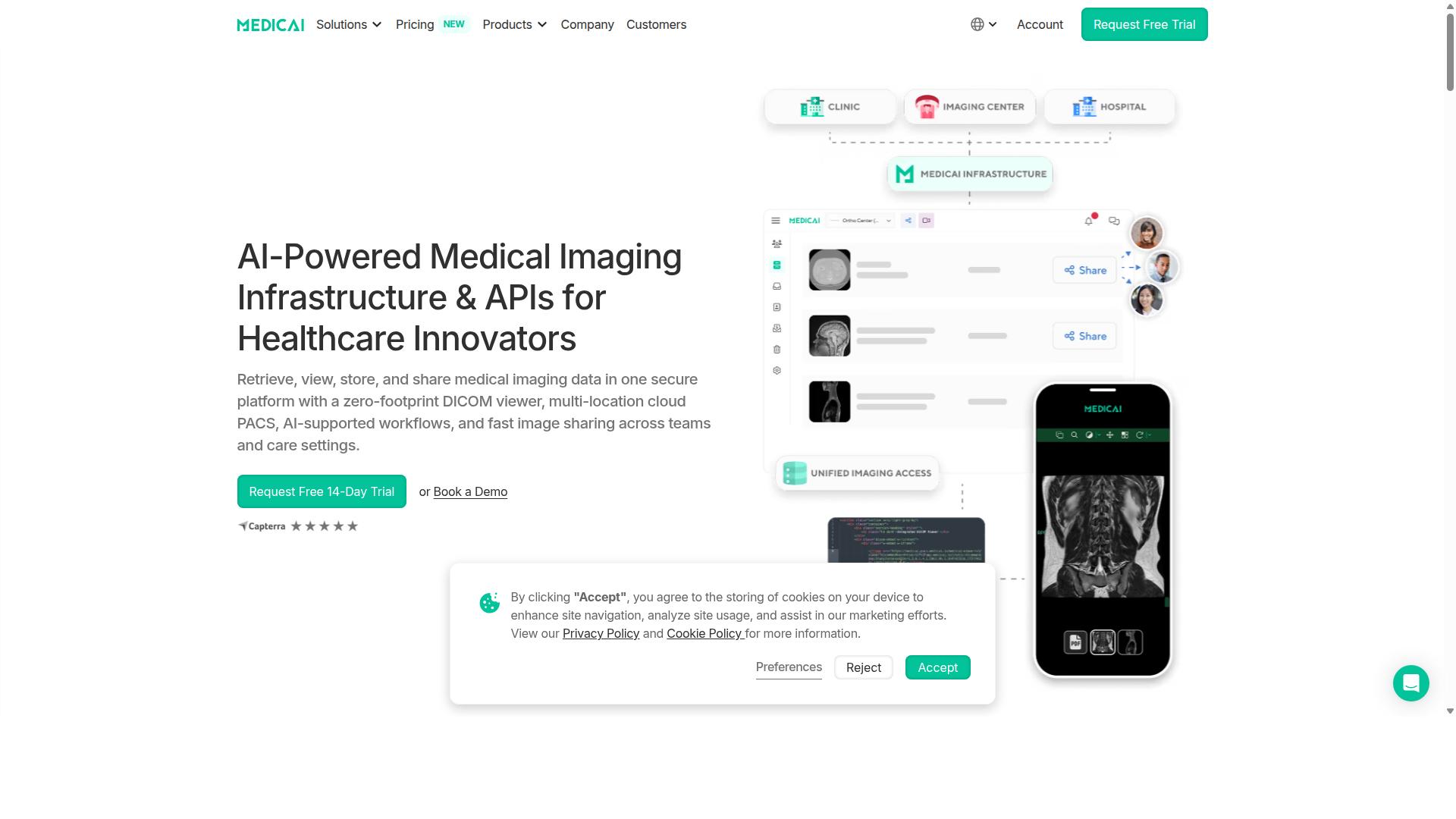
Medicai operates as a cloud-based medical imaging platform that unifies retrieval, viewing, storage, and sharing in a single HIPAA and GDPR compliant environment.
The platform functions as Imaging Infrastructure as a Service. This model lets hospitals, imaging centers, and specialty practices access enterprise imaging tools without managing physical servers or complex maintenance schedules.
Its core architecture centers on a zero-footprint DICOM viewer. This viewer works across web browsers without requiring local software installation or updates.
The system includes multi-location cloud PACS capabilities. These capabilities support multiple sites through centralized access while maintaining local performance standards.
Medicai stands as a VC-backed healthcare startup. The company focuses on modernizing medical imaging workflows through improved interoperability between different systems and care settings.
Clearance status includes FDA and CE mark approvals for its viewer specifications. These clearances ensure the platform meets regulatory requirements across global healthcare markets.
Availability extends to hospitals, imaging centers, and specialty practices worldwide. The platform supports AI-supported workflows that enhance existing radiology processes without replacing established clinical procedures.
Security features address both HIPAA and GDPR requirements. These features enable fast image sharing across teams while maintaining compliance standards throughout the data lifecycle.
What Is Ambra Health?
Ambra Health provides cloud-based medical imaging solutions for hospitals and imaging centers with vendor-neutral archive capabilities. The platform stores images in a centralized system that supports DICOM formats and basic interoperability standards. Healthcare providers can access these images through web-based viewers that require no local software installation.
Many organizations use Ambra Health to simplify image sharing across different facilities. The service handles data migration from existing PACS systems and supports HL7 connections for patient information exchange. Cloud storage reduces the need for on-site hardware maintenance and allows remote access to studies.
Vendor-neutral archive functionality helps avoid certain types of vendor lock-in by storing data in standard formats. This approach gives facilities more flexibility when they need to change imaging vendors or integrate new systems. The platform also provides basic role-based access controls to manage who can view or modify patient records.
Implementation typically involves connecting existing radiology workflows to the cloud service. Staff can upload studies, retrieve prior exams, and share images with referring physicians through secure links. The system maintains audit logs for compliance purposes and supports HIPAA requirements for protected health information.
Ambra Health operates as a SaaS model, which means customers pay subscription fees rather than purchasing software licenses outright. This deployment model appeals to facilities that prefer predictable costs and want to avoid managing physical servers. The service also provides API access for organizations that need to connect the archive with other clinical applications.
Features Compared
Feature-by-feature analysis reveals distinct approaches to archive architecture, multi-site connectivity, and regulatory compliance between these platforms.
Medical imaging departments need reliable vendor-neutral archive solutions that support DICOM storage, image exchange, and long-term data management. The comparison below examines three critical areas where these platforms differ.
Cloud PACS and Vendor-Neutral Archive Architecture
Medicai's Cloud PACS and Vendor Neutral Archive handles 1.7M+ studies with vendor-neutral storage while Ambra Health positions itself as a VNA solution.
Medicai provides specific data migration tools through its DICOM Gateway and Medical Imaging Uploader services. These components support seamless transfer from existing PACS systems into the cloud environment.
Backup and Disaster Recovery capabilities ensure data protection across multiple Azure regions. This architecture supports enterprise imaging requirements without traditional hardware investments.
Ambra Health offers general VNA positioning but lacks detailed specifications about migration processes or recovery protocols. Organizations evaluating vendor-neutral archive options benefit from platforms with documented backup procedures and migration support.
Multi-Location Data Access and Sharing
Real-time access across connected locations requires robust exchange protocols and patient portal integration for both platforms.
Medicai's Medical Image Exchange enables image sharing between connected sites through its standard connectivity framework. The Patient Case Management system supports workflow coordination across different locations.
The Standard tier supports one connected location with upgrade paths available for multi-site deployments. This tiered approach allows organizations to scale connectivity based on operational needs.
Ambra Health provides general multi-location sharing capabilities without specific tier definitions or connectivity limits. Both platforms support patient portal access, though implementation approaches vary.
Security, Compliance, and Scalability
Healthcare imaging platforms must meet strict compliance standards while scaling storage and maintaining uptime across enterprise deployments.
Medicai maintains HIPAA and GDPR compliance with FDA/CEE cleared viewers for diagnostic use. The platform has processed 300k+ DICOM visualizations in the past year while following OWASP security guidelines.
Microsoft Azure partnership provides enterprise-grade infrastructure for scalability requirements. Organizations benefit from this established cloud foundation when planning long-term archive growth.
Ambra Health presents general security positioning without specific compliance certifications or performance metrics. Medicai's documented compliance framework and cleared viewer technology offer clearer regulatory positioning for healthcare organizations.
Pricing Compared
Transparent monthly billing structures differentiate these platforms across storage tiers and connected location allowances. Medicai publishes its pricing directly on the website while Ambra Health typically requires direct sales contact for cost details.
Medicai offers three clear tiers for medical imaging environments. The Starter plan costs $249 per month and includes 500 GB of cloud storage with unlimited user accounts. No connected locations are included at this level.
The Standard plan at $749 per month provides 2 TB of cloud storage along with unlimited user accounts and one connected location. DICOM Gateway setup carries a one-time fee of $1,000 per location.
Enterprise customers receive custom pricing for larger storage requirements along with multiple connected locations and external site access. Yearly billing reduces costs by 15 percent across all published tiers.
Ambra Health follows a traditional enterprise pricing model that often involves custom quotes based on volume and specific organizational needs. This approach can create uncertainty during early budget planning stages.
Per-study pricing options are available for enterprise customers on both platforms. Medicai includes a free 14-day trial of Starter plan features without requiring a credit card.
Who Should Choose Medicai
Healthcare organizations processing over 1M studies annually benefit from documented performance metrics and transparent pricing structures. Hospitals, imaging centers, and specialty providers in radiology, cardiology, and orthopedics find value in solutions that scale without requiring infrastructure investments.
Zero-footprint viewing eliminates the need for local software installations across multiple departments. Organizations can access imaging studies from any location while maintaining security protocols required for clinical workflows.
API access supporting 50M+ yearly transactions suits health systems with high-volume data exchange needs. This capability enables seamless connections between existing systems without disrupting established radiology workflows or requiring major IT overhauls.
Storage tiers ranging from 500 GB to 2 TB accommodate facilities at different stages of digital transformation. Organizations can adjust capacity based on actual usage patterns rather than purchasing excess infrastructure upfront.
The vendor-neutral approach prevents lock-in situations that can occur with proprietary archive solutions. Healthcare providers retain control over their imaging data while gaining interoperability features that support future system migrations or consolidations.
Who Should Choose Ambra Health
Organizations prioritizing vendor-neutral archive solutions may find Ambra Health suitable for their specific workflow requirements.
Hospitals and imaging centers looking for cloud-based VNA options often evaluate multiple platforms before making decisions. The selection process depends on factors like current PACS infrastructure and data migration needs.
Ambra Health focuses on serving facilities that want cloud storage for medical imaging data. These organizations typically handle DICOM files across multiple departments and need basic interoperability features.
Some institutions prefer established vendors with existing relationships in the healthcare market. They may value familiarity with certain deployment models over newer alternatives.
Facilities considering Ambra Health usually examine integration capabilities with existing systems. The evaluation process includes reviewing how well the solution handles image exchange between different departments.
Cost considerations also influence decisions for smaller imaging centers with limited budgets. Organizations compare pricing structures and implementation requirements across available vendor-neutral archive options.
Support needs vary depending on internal IT resources and technical expertise. Some facilities prefer vendors with established customer service frameworks for troubleshooting and maintenance.
Final Verdict
The decision between Medicai and Ambra Health hinges on verified performance data, transparent pricing, and specific multi-location requirements.
Medicai has processed 1M+ studies and stores 1.7M+ studies across its vendor-neutral archive platform. This volume demonstrates proven capacity for enterprise imaging environments across multiple sites.
Its tiered pricing structure ranges from $249 to $749 monthly, offering predictable costs that scale with organizational needs. This model provides clarity during budget planning for facilities evaluating long-term archive solutions.
Ambra Health maintains a general market position without publicly disclosed study volumes or transparent pricing tiers. Organizations comparing vendor-neutral archives benefit from understanding exact data handling capacity and monthly costs before committing to either platform.
Medicai USA operates from 7901 4th St N, STE 300, St. Petersburg, FL, 33702 with phone support at +1 (832) 220 1035. The European office is located at 53-55 N Filipescu, 5th Floor, Sector 2, Bucharest, 020961 and can be reached at +40 316 305 875.
Organizations seeking vendor-neutral archive capabilities can contact [email protected] to discuss specific deployment needs, data migration requirements, and integration with existing PACS and DICOM workflows.